What Makes a Coastal Promenade More Than a Seaside Path
Learn how a coastal promenade differs from a seaside path, and read its paving, seating, and boundaries to understand the public life its design supports.
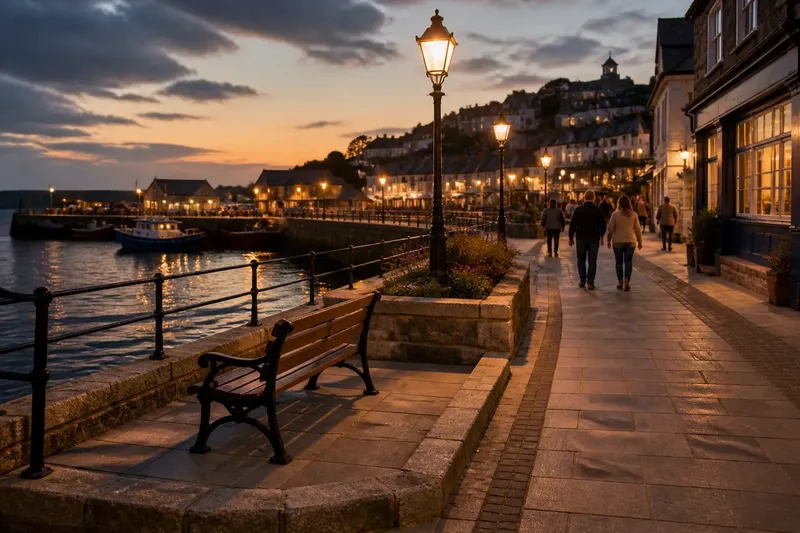
The common mistake is to call every path beside the sea a coastal promenade. That can hide a more useful question: what kind of public place does the design create, and whose presence does it make comfortable? A promenade’s paving, furniture, and edge can reveal how a town has chosen to frame everyday life beside the water.
A promenade is shaped by its public setting
A seaside path may chiefly connect one point to another. A promenade can also do that, but its design gives attention to the experience of being there: a sheltered seat, an outlook, a plaza, or a place where the route meets a town street.
These features are not a formula. A narrow walk can function as a promenade when it makes room for public use, while a broad paved strip may feel like a corridor if there is nowhere comfortable to pause. The name on a map matters less than how the space is arranged and maintained.
The distinction becomes clearer by considering the promenade as part of a town’s public realm. Its role may depend on what lies behind it: homes, shops, a ferry landing, a harbor, or a street used by residents. The waterfront is not an isolated stage; its connections shape who can reach it and what people might do there.
Seating and paving reveal who the design serves
Small design choices can send strong signals. A bench facing the water offers a different invitation from one placed beside a busy route, while a sheltered corner may make a stop more comfortable than an exposed stretch with no place to rest.
Paving also affects how a space is understood. A clear, continuous walking surface can help people follow the route; a change in texture may distinguish a gathering area or mark a transition to another part of the waterfront. These choices can clarify how to move through the space without dictating a single way to use it.
Consider the placement of furniture as a question of shared use. If seats sit directly in a narrow passage, stopping can conflict with walking. If the layout provides a separate nook or widened landing, people can linger while others continue past.
- Seat orientation: If benches face the water or a public gathering place, the design invites watching and conversation; if they face a blank wall or a service area, consider whether another location would better support public use.
- Clear walking line: If furniture leaves a legible path past places to stop, different paces can coexist; if seats narrow the route, relocate the stopping area or preserve a wider passage.
- Paving transitions: If a change in surface clearly marks a plaza or outlook, it can help visitors understand where gathering is welcome; if it creates confusion or an awkward crossing, simplify the transition.
- Shelter and exposure: If a place to sit offers some shelter from wind or sun, it may support longer pauses; if it remains exposed, a more protected location may be more useful.
- Connections inland: If public streets, transit, or local destinations connect directly to the waterfront, it is easier to use as part of ordinary town life; if access depends on a single remote entrance, improve the connection or make the entry clearer.
- Maintenance signs: If paving, benches, and railings are usable and cared for, the public invitation is easier to trust; if damage or clutter obstructs use, address maintenance before adding new features.
Imagine a town’s harbor walk has a narrow passage with benches placed in the main line of travel. In this invented situation, the town maps the clear route, notes that people must weave around seated visitors, and shifts the benches onto a nearby widened landing while keeping the water view. The expected result is a distinct place to stop and a clearer route past it; if the landing blocks an access point, the alternative is to move the seating to another open area.
Boundaries express how a town meets the water
Railings, low walls, steps, ramps, and changes in level do more than mark an edge. They shape whether people view the water from a distance, approach it at selected points, or move between different levels of the shoreline.
A continuous barrier may help make the route legible, while an opening can connect a promenade to a lower landing. Neither arrangement is inherently more public. The practical question is whether the boundary fits the place’s uses and access needs.
Along a working harbor, the shore may include operations that need separation from public movement. In a town park, a gentle slope or steps may be part of the public experience. The same design choice does not suit every shoreline, and structural or safety changes call for guidance from the relevant local authority or a qualified professional.
Promenade history is visible in civic details
Many promenades were deliberately organized as public seafronts, rather than left as leftover ground between town and water. Their terraces, railings, open platforms, and gathering spaces made the shoreline a recognizable civic setting as well as a place for recreation.
That history does not mean every promenade follows one model. Some are formal, with ornamental structures and carefully ordered views; others rely on a simple continuous walk, occasional seating, and direct links to streets. Their shared idea is a public edge intended for more than transit.
Look at how features relate rather than treating any single bench or railing as proof of a promenade’s purpose. A terrace joined to a public entrance and a gathering space suggests a different civic ambition from an isolated viewing platform beside a service road.
How can a coastal promenade be read in practice?
Does a promenade need to be wide or ornate?
No. Width and decoration can shape the experience, but they do not define it. A modest walk may serve as a promenade if it supports public presence and connects sensibly to the surrounding place.
Can a promenade include restricted areas?
Yes. Working waterfronts may need secure or operational zones beside public space. Clear boundaries and routes can show where public access ends and harbor activity begins.
What does a barrier say about public access?
A barrier may keep people safely back from the water, guide movement, or mark an operational edge. Look for how openings, views, and alternative access points work together rather than assuming that a railing alone signals exclusion.
How do I tell if seating is well placed?
Notice whether people can stop without obstructing the route or an entrance. If the seats interrupt movement, a nearby widened area may provide a better location.
A promenade shows a town’s priorities
A waterfront’s design makes civic choices visible in ordinary materials. The route, seating, boundaries, and links inland can show whether the town treats the shore as a scenic backdrop, a working edge, a social setting, or several of these at once.
For a useful reading of a coastal promenade, follow one connection from the town to the water: note where the public route begins, where it offers a place to pause, and where its boundary changes. That sequence can reveal more about the intended public life than the promenade’s name alone.
One last detail is worth checking: who is expected to maintain the space. A design may invite broad public use, but clear responsibility for litter, repairs, and seasonal closures helps that invitation remain understandable over time.