Sand, Shingle and Rock: What the Shore's Surface Can Tell You
Learn how to describe a shoreline from its sand, shingle, rock, and shape without mistaking one visible feature for the whole coastal story.
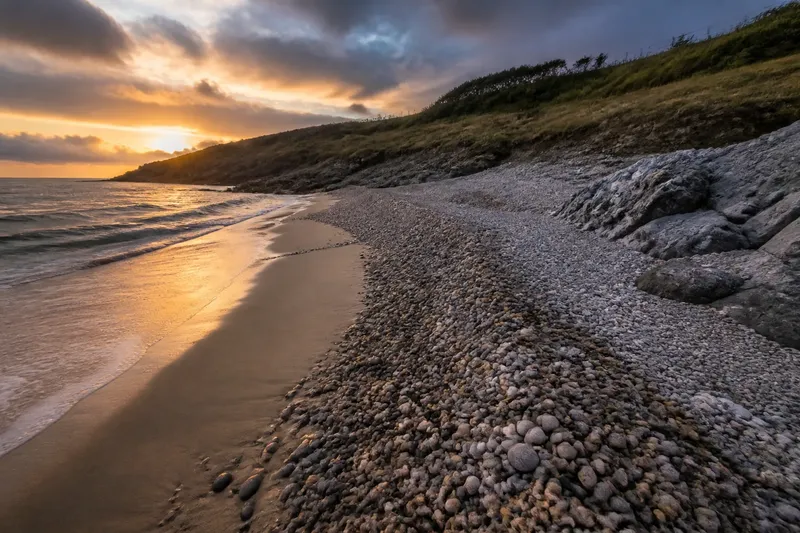
The most common mistake in describing a beach is naming its most obvious material and treating that as the whole story. A note such as “rocky shore” can miss a broad sand apron, a band of rounded pebbles, or the way the surface changes from the water’s edge to the back of the beach. Careful shoreline description starts with what is visible, then records where each feature occurs.
1. Start with a simple material map
Stand where you can see a useful stretch of shore and divide it into broad zones: the water’s edge, the middle of the beach, and the upper shore near dunes, a seawall, or vegetation. Describe the dominant material in each zone rather than assigning one label to the entire view.
Use familiar terms precisely. Sand consists of loose grains; shingle usually means a spread of pebbles or small stones; and a rocky shore may include exposed bedrock, boulders, or both. If the material is mixed, say so: “sand with scattered cobbles” tells a reader more than “mixed beach.”
Keep the description observational. “A narrow strip of dark sand lies below a field of rounded pebbles” records visible details without claiming how the beach formed.
2. Notice grain size and shape
Material size affects the texture of a shore and the way it looks underfoot. Fine sand can appear smooth from a distance, while coarse sand may show distinct grains. Shingle ranges from small pebbles to larger cobbles, and bedrock may form continuous ledges rather than loose pieces.
Shape matters as well. Rounded stones have softened edges; angular fragments have sharper corners. A shore can contain both, so describe the range instead of choosing whichever form is easiest to spot.
For consistency, compare items of similar size and look at several parts of the beach. One striking stone is not enough to describe the whole surface. Avoid picking up or moving material in places where signs ask visitors to leave it undisturbed.
3. Read the shore from edge to back
A beach is not a flat strip. Its surface may slope gently, rise steeply, or form a low ridge before the landward edge. These shapes are visible clues worth recording, but they do not, by themselves, identify the process that created them.
Look for where the slope changes. A distinct step between wet sand and dry sand, a ridge of pebbles, or a hollow behind that ridge can make the profile easier to describe. Use relative language such as “steeper near the water” or “a low ridge runs parallel to the shoreline.”
Imagine you are describing a cove to someone who cannot see it: the lower shore is smooth sand, a curved band of pebbles sits above it, and exposed rock borders one end. That description gives the reader a simple mental map without pretending every part of the cove is the same.
4. Record bands, patches, and boundaries
Many shorelines show materials in bands rather than in a single, even layer. Sand can fill gaps between rocks; pebbles can gather along the upper beach; and patches of bedrock can emerge through loose sediment. Note whether boundaries are sharp, gradual, or interrupted.
Describe direction only when it is clear from your viewpoint. “A pebble band runs along the upper shore” is useful; “the pebbles were carried here by a particular storm” is an explanation that visible appearance alone may not support.
Small details can clarify the pattern: shells mixed into sand, a narrow line of drift material, or stones gathered in a shallow hollow. Treat these as features of the scene, not as proof of a single cause.
5. Keep water, weather, and viewpoint in the record
The same stretch of coast can look different as the tide covers or exposes parts of it. A low waterline may reveal rock ledges and pools that disappear at a higher tide. Wet sand also tends to look darker than dry sand, so mention the condition if color is important to your description.
Weather can affect what is visible. Wind may move loose sand across the surface, while rain can make grain boundaries less distinct. Note what you observed rather than assuming a temporary appearance is permanent.
Viewpoint matters too. From a raised path, a narrow pebble strip can seem insignificant; from the beach, it may dominate the foreground. If the position changes your view, say where you were standing in ordinary terms, such as “from the access path” or “near the water’s edge.”
6. Separate what you see from what you infer
A good shoreline description distinguishes direct observation from interpretation. “Angular stones lie below a low rock ledge” is visible evidence. “The ledge is eroding quickly” is a broader conclusion that requires more than a passing glance.
Choose verbs that match your confidence. “Contains,” “shows,” and “is bordered by” describe appearance. Words such as “formed by,” “retreating,” or “protecting” make claims about causes, change, or function and should be used only when you have a sound basis for them.
This distinction is especially useful when comparing places. Two beaches can both be called sandy, yet differ in slope, width, grain size, and the amount of exposed rock. A precise description keeps those differences visible without assigning a complete history to either one.
7. Common shoreline description questions?
What is the difference between shingle and gravel?
Both terms refer to loose stones, and their use can vary by location. In a general description, “shingle” commonly suggests a beach made of rounded pebbles, while “gravel” can refer more broadly to small loose rock fragments.
How can I describe a beach with several materials?
Name the materials and their positions: for example, “sand at the water’s edge, with pebbles above and exposed rock at the headland.” This makes the mixture clear without forcing the beach into one category.
Does a rocky beach have to be covered in bedrock?
No. “Rocky” can describe a shore dominated by loose boulders or cobbles as well as one with exposed bedrock. If the distinction matters, name the visible form rather than relying on the broad label.
Can a beach’s surface reveal how it is changing?
A single visit can show features that may be relevant to change, such as exposed rock or a shifted-looking band of loose material, but it cannot establish a trend on its own. Repeat observations from a safe, consistent viewpoint can make comparisons more informative.
8. Make the final description specific and modest
Before finishing, check whether your account names the main materials, shows how they are arranged, and gives at least one detail about shape or slope. Remove a claim about cause if the view does not support it. Where an official sign, site manager, or local authority sets access or conservation rules, follow that guidance.
A useful description of sand, shingle, and rock does not need specialist terminology. It needs a clear order: say what is present, where it lies, and how the shore changes across the view. That small discipline makes the shoreline easier to compare and leaves room for the coast to be more complicated than its first impression.